
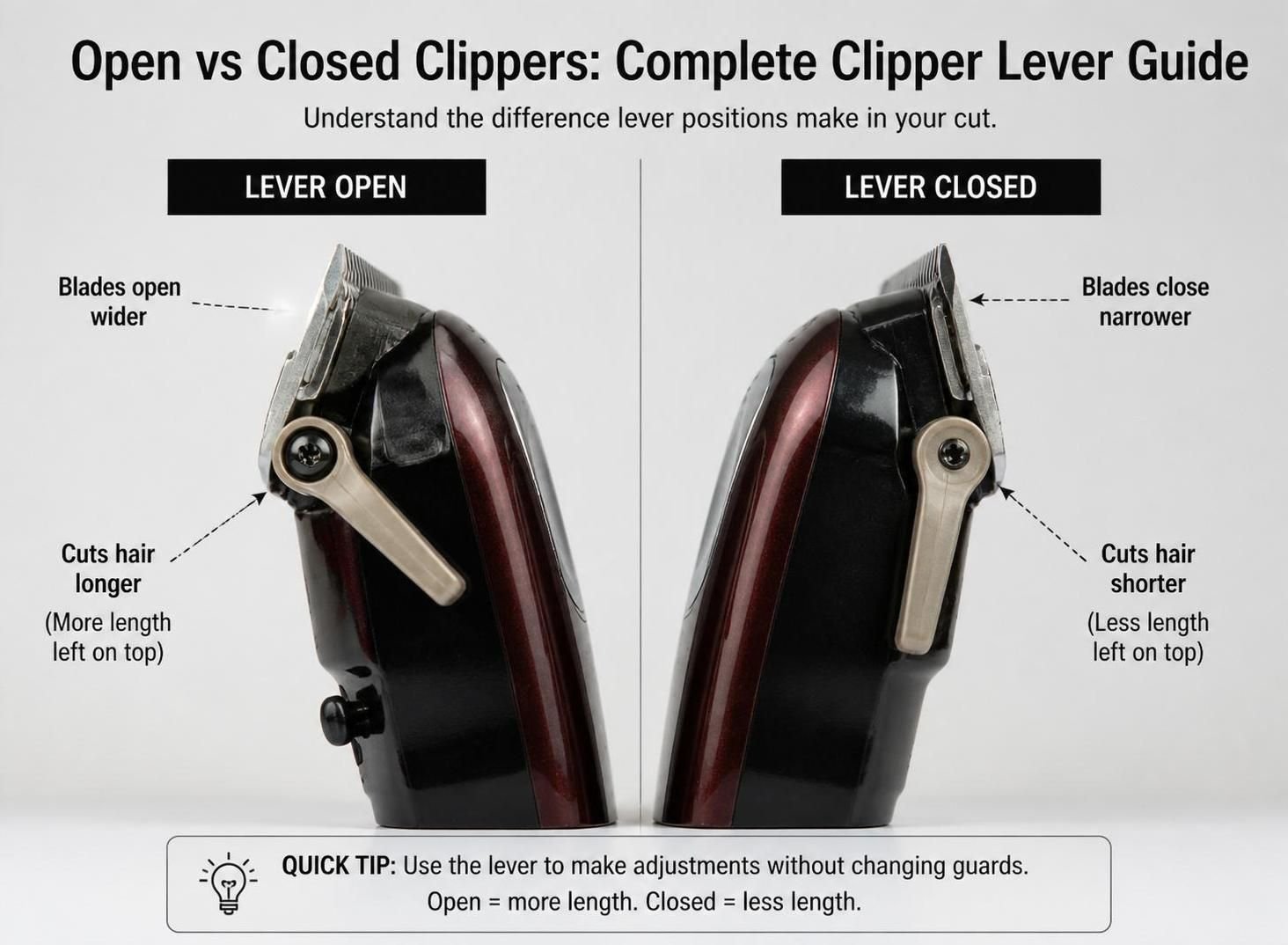
Understanding open vs closed clippers is one of the most important skills a barber or home groomer can learn, since the clipper lever position controls exactly how much hair gets removed with every pass. An open clipper exposes more of the blade for bulk hair removal, while a closed clipper keeps the blade tight against the guard for precise, close-cutting detail work. Knowing when to use an open clipper versus a closed clipper directly affects how smooth your fade looks, how clean your lineup turns out, and how comfortable the entire haircut feels. This guide breaks down exactly how the hair clipper lever works, when to adjust it, and how professional barbers use both settings to achieve sharp, blended, professional results.
What Is an Open Clipper?
An open clipper is a setting where the clipper blade lever is pushed forward, which raises the top blade away from the bottom blade. This creates more space, or blade gap, between the two cutting surfaces. The result is a longer, less aggressive cut that removes bulk hair quickly without taking it down too short.
Open clipper blades are commonly used at the beginning of a haircut, when there’s a lot of length to remove. Since the blade exposure is higher, an open clipper glides through thick, long hair more efficiently than a closed setting, making it ideal for bulk hair removal and initial haircut foundation work.
What Is a Closed Clipper?
A closed clipper is the opposite setting, where the clipper lever is pulled back so the top blade sits flush against the bottom blade. This closed blade position minimizes the blade gap, allowing for a much closer, more precise cut.
Closed clipper blades are the go-to choice for detail work like lineups, edge ups, shape ups, and outlines, where precision matters more than speed. Because the blades sit so close together, a closed clipper setting also works well for creating sharp fade transitions and clean, crisp edges around the hairline.
Open vs Closed Clipper Blades: Key Differences
| Factor | Open Clipper | Closed Clipper |
|---|---|---|
| Blade gap | Wider gap, more blade exposure | Minimal gap, blades sit close together |
| Cutting length | Leaves hair slightly longer | Cuts hair very short and close |
| Best use | Bulk hair removal, initial pass | Lineups, fades, detailing |
| Precision | Lower precision, faster coverage | High precision, slower and controlled |
| Beginner friendliness | Easier and safer for beginners | Requires more control and confidence |
| Common technique pairing | Clipper over comb, rough cutting | Zero gap fading, edge work |
When to Open the Clipper Lever
Knowing when to open clipper lever settings comes down to the stage of the haircut and the amount of hair you’re working with. Barbers typically open the clipper lever during these situations:
- Removing bulk hair. When hair is long or thick, an open clipper reduces length faster without going too short too soon.
- First pass of a haircut. Most professional barber techniques start with an open blade to establish the overall haircut foundation before refining details.
- Blending longer sections. An open clipper works well for softening the transition between longer top hair and shorter sides during a taper fade.
- Working with guide combs. Using an open clipper with a guard attached helps distribute even length across larger sections of hair.
When to Close the Clipper Lever
Knowing when to close clipper lever settings is just as important, since this stage focuses on precision rather than speed. Barbers typically close the clipper lever for:
- Creating a skin fade or bald fade. A closed, near zero gap clipper setting is essential for achieving that smooth, faded-to-skin look.
- Lineups and edge ups. Sharp, crisp outlines around the hairline and beard require the tight blade control that only a closed clipper can deliver.
- Final blending passes. After bulk removal, closing the lever gradually helps blend uneven sections into a smooth, professional finish.
- Detail work on sensitive areas. Around the ears and neckline, a closed clipper offers more control, reducing the risk of accidental clipper cuts.
How the Taper Lever Affects Fade Haircuts
The taper lever is the mechanism that physically moves the blade between open and closed positions, and mastering its use is central to achieving a clean fade haircut. For a low fade, mid fade, or high fade, barbers gradually adjust the lever between passes, moving from a more open setting at the top of the fade zone to a closed, near zero gap clipper setting near the skin.
This gradual lever adjustment is what creates the smooth gradient effect seen in a well-executed skin fade or bald fade. Skipping steps, or jumping straight from a wide open blade to a fully closed one, often results in visible demarcation lines instead of a seamless blend.
Common Clipper Problems and How Lever Position Helps
Many haircut issues trace directly back to incorrect clipper lever positioning. Understanding these problem-solution pairs can dramatically improve haircut precision.
Clipper pulling hair. This often happens when the blades are too closed for the hair length being cut. Opening the clipper lever slightly usually resolves this issue.
Uneven fade or bad haircut blending. This is frequently caused by jumping between lever positions too abruptly. Smooth fades require several intermediate lever adjustments rather than a single jump from open to closed.
Clipper leaving lines. Visible lines in a fade usually mean the transition between guard sizes or lever positions was too sudden. Blending with a slightly open clipper between each guard change helps eliminate visible lines.
Accidental clipper cuts. These are more common with a fully closed clipper, especially around bony areas like the ears and neckline. Using a slightly more open setting in sensitive areas improves scalp protection.
Clipper Guards and Lever Settings Together
Guide comb sizes and lever position work together, not separately. A guard comb haircut combined with an open clipper setting removes more length per pass, while the same guard paired with a closed clipper setting creates a tighter, closer cut underneath the guard. Adjusting both the guard size and the lever position gives barbers precise control over final hair length across every section of a haircut.
Open Clipper vs Zero Gap Clipper
A zero gap clipper is essentially the most extreme closed clipper setting, where the blades sit with virtually no space between them at all. This setting is specifically used for skin-level fades and the sharpest possible lineups. While a standard closed clipper still leaves a small blade gap, a true zero gap clipper blade alignment is often achieved through additional adjustment beyond the standard lever, sometimes requiring blade replacement or specialized adjustable blade clippers designed for zero gap work.
Brand Comparison: Wahl, Andis, and Oster Lever Systems
Different barber clippers implement the open and closed lever mechanism slightly differently, which is worth understanding before choosing your equipment.
Wahl Senior and Wahl Balding Clipper. Wahl clippers are known for a simple, reliable taper lever that smoothly transitions between open and closed positions, making them a popular choice among beginner barbers learning open vs closed clipper fundamentals.
Oster Classic 76. The Oster Classic 76 is widely respected for its detachable blade system, which allows barbers to swap in specialized zero gap blades for more advanced fade work beyond the standard lever range.
Andis Fast Feed. The Andis Fast Feed is favored for its adjustable blade clippers design and strong motor, making it effective for both bulk hair removal with an open setting and detailed closed-blade fade work.
Ufree Trimmer. As a more budget-friendly cordless clipper option, the Ufree Trimmer offers basic open and closed adjustment suited well to beginner barber guide use and at-home grooming.
Beginner Tips for Practicing Open vs Closed Clipper Technique
For anyone new to clipper work, practicing lever control safely is essential before attempting detailed fades or lineups.
- Start with the clipper fully open and guard attached for your first few practice sessions.
- Gradually reduce guard size and slightly close the lever as your comfort and control improve.
- Practice smooth, gradual lever transitions rather than sudden open-to-closed jumps.
- Always support the ear and neckline with your free hand when using a closed clipper setting near sensitive areas.
- Watch clipper motor speed and blade heat, since prolonged closed-blade use can cause the blades to warm up and feel less comfortable against skin.
Frequently Asked Questions
Should clippers be open or closed for fading?
Fading generally starts with a more open clipper for the upper blending zone, then gradually moves to a closed or near zero gap setting closer to the skin for a smooth, professional transition.
Should clippers be open or closed with guards?
When using guide comb attachments, clippers are typically kept in a more open position, since the guard itself already controls the cutting length and an open blade allows smoother movement through the guard.
Can you fade with open clippers?
Yes, open clippers are often used for the initial blending stage of a fade, but achieving a truly smooth skin fade usually requires transitioning to a closed or zero gap setting for the lower sections.
Can you cut hair with closed clippers?
Yes, closed clippers are ideal for short, precise cutting such as lineups, edge ups, and the final stages of a fade, though they are not recommended for removing large amounts of length quickly.
How do you zero gap clippers?
Zero gap adjustment typically involves aligning the top and bottom blades so there is no visible space between them, which may require loosening blade screws slightly, aligning the blade teeth evenly, and retightening for a flush, zero gap clipper blade alignment.
When should I use open clippers?
Open clippers are best used at the start of a haircut for bulk hair removal, and during the early blending stages of a fade before transitioning to more closed, precise settings.
Key Takeaways
- Open clippers remove bulk hair quickly with a wider blade gap.
- Closed clippers deliver precise, close cuts ideal for lineups and fades.
- Smooth fades require gradual lever transitions, not sudden jumps.
- Guard size and lever position work together to control final hair length.
- Practicing lever control safely is essential before attempting advanced techniques.
Conclusion
Mastering open vs closed clippers is a foundational barbering skill that directly shapes the quality of every haircut, from simple trims to complex skin fades. Using an open clipper for bulk removal and a closed clipper for precision detailing gives barbers and home groomers full control over length, blending, and sharp finishing lines. With practice, gradual lever adjustments, and a solid understanding of how the clipper lever interacts with guide combs and blade gap, anyone can achieve smoother fades, cleaner lineups, and more professional, confident haircut results.